SOUND
Diegetic - sound that you can see coming from the world on screen, e.g. a character visibly playing piano.
Non-diegetic - a noise which does not have a source on-screen, they have been added in in post production.
Diegetic music may signify the target audience including the gender, age and social class. Diegetic music that may signify a younger male C2DE audience would be rock or heavy metal. Whereas diegetic music that may signify an older ABC1 audience would be classical music, like Beethoven.
Ambient sound and Foley sound are typically recorded prior to a main film shoot, and help with continuity editing.
In Shaun of the Dead, there is non-diegetic sound used during the title sequence showing people acting like zombies, the song played here is 'The Blue Wrath' by I Monster.
In the film opening of 'This is England', diegetic sound used includes audience members screaming, although this doesn't appear diegetic at first as you cannot see the audience.
Non-diegetic sound in the opening of 'This is England', includes helicopter blades spinning, and the song played when they step on stage is also non-diegetic. It also interacts with the WARP FILMS title.
1st SHOT
The first shot of a film opening typically shows a lot of exposition, however, there is also almost always narrative enigma. An exception to the narrative enigma would be in the 1st shot of Shaun of the Dead, where you see the main protagonist immediately.
The protagonist is usually not shown fully throughout the beginning of a film to add to suspense, and create narrative enigma. Narrative enigma is shown in the above clip from Shaun of the Dead from 3:35 to 3:47.
The mise-en-scene provides the audience with exposition regarding the characters, usually the main protagonist, as they are the character the movie is based around. Mise-en-scene in the clip above is shown from 3:50 to 4:20
The Hand of God technique is often used as a 1st shot in a film opening, as it provides exposition, narrative enigma and sets the scene for the film, and provides us with a good idea of who the main protagonist is.
CENTRAL PROTAGONIST + NARRATIVE
Todorov's 5 plot point theory, is the theory that all films follow a certain format, where the film starts out in equilibrium, there is then a disruption to this equilibrium, followed by a recognition of the disruption, an attempt to repair or fix the disruption, and then a new equilibrium.
Levi Strauss theorized that all films have binary opposition, this is when one character is a direct opposite to another.
Proppian Archetypes include, the hero, helper, villain, false hero, donor, dispatcher and princess. These are all character types which show up in films
'71

- Dark colours used in poster anchor the connotation that this is an action film.
- Medium shot, showing facial expression as well as what is being held, further anchors action film
- Dark colours also set the tone of the film, and the mind of the protagonist, setting the film as dark and serious, showing the protagonist as troubled.
- Facial expression - Mouth slightly opened to show he is shocked.
...
THIS IS ENGLAND

- Red, White and Blue title anchor the film as being set in the UK
- Working Class representation
...
TYRANNOSAUR

- Rule of thirds, centrally framed connoting this man as the protagonist
- However, prop, lighting, mise-en-scene etc connote he could be the antagonist
- Own binary opposition - creating narrative enigma
- Serif font signifying a drama genre
- Wrinkles - older man - older audience
- Skin head, vest top - working class
- Terraced houses on edge of poster - working class
- Dark weather - drama
- High key lighting on only one side - reflects his two different personalities - drama
- Small 'a film by Paddy Considine' denotes auteur theory
- 2 awards won & reviews to lead promotion
- High angle - surprising for protagonist
- Bare tree - drama
- Violence - in this shot - violence to himself - self-loathing
- Contemplating - not stupid like the stereotypical working class
- Narrative enigma - what is he regretting?
- Names but not big or bold
...
DEAD MAN'S SHOES
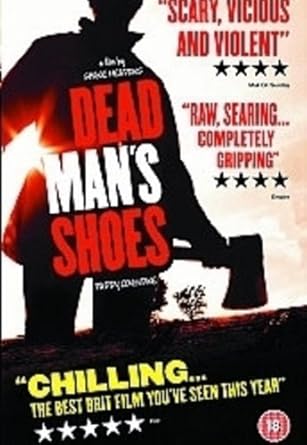
- The silhouette of the man is a signifier and it signifies a theme of mystery and darkness. This is anchored by the written reviews on the poster.
- The axe being held by the silhouette of the man is a denotation, this connotes the perhaps evil intentions of the man. This is anchored by the use of the colours red and black which can connote a horror-like atmosphere.
- The low angle signifies a dangerous character. Names are smaller than the reviews.
...
IDENTS
- Only one company ident - Paramount Pictures
- With recent films there are usually more than one ident
TITLES IN ORDER
- PARAMOUNT PICTURES PRESENTS - upper case and sans-serif -
- Black and white connoting seriousness/sophistication/drama genre.
- Polysemic title - sans-serif font with white on black.
- A JOHN HUGHES PRODUCTION - all upper case, sans-serif.
- Expected auteur theory
- usually "Film" and not "Production".
SHOTS
- Exposition shot - narrative enigma. Some degree of context - a working class area (grass growing over pavement, rusty car, broken roads)
- Panning shot showing both sides of the track - Born/from the wrong side of the tracks - One side is a nice area than the other.

No comments:
Post a Comment