AGE The age range we are targeting our film for is between 15-24, and all the characters in our film opening are in their early 20's. The Uses and Gratifications theory can be applied here, as we would want our audience to identify with our characters, we would want them to identify with Donnie in particular. The character of Donnie is the archetypal buffoon in our film opening, we incorporated aspects of Charlie Chaplins character as well as Nick Frost's character in Shaun of the Dead. Many people may identify with the short piece of romance we have in our film opening, between Mia and Donnie. Mia fits the proppian archetype of prize/princess, which we linked to Laura Mulvey's theory of male gaze. The character of Donnie is connoted by his clothing, he wears loose fitted clothes that aren't branded and wears glasses that may be considered uncool. The character of Donnie is also portrayed as a heavy drinker.
Since we are creating a zom-rom-com film opening, it means that an entire film would likely have gore and violence in it, along with swearing and profanity to createverisimilitude, our film would likely have a BBFC rating of 15. GENDER The gender we are targeting this film to would be male, as our protagonist is a male, this would ensure identification further. The comedy aspect of our film opening is also preferred among a male audience, however the romance aspect of our film opening is preferred by a female audience. As Donnie is a basic stereotype for men, being messy, clumsy and careless the male audience will identify more, in comparison to the female audience.
ECONOMIC GROUPING We aim to target a middle-class audience, that fits specifically into the C1C2 section, we don't want to just limit our target audience to this class. Uses and Gratifications can be applied again, as our main protagonist (Donnie) fits into the middle class. NATIONALITY/REGION The only dialogue spoken in our opening scene is from Mia, the proppian princess/prize. The character has a posh Southern English accent, meaning it would be easily understood by the audience. As the protagonist of our film opening is from Zimbabwe, the accent of the actor/character becomes slightly more niche, limiting the percentage of audience who are able to understand it.
FANS OF... Fans of the Cornetto trilogy would enjoy our film opening, as we take direct influence from Shaun of the Dead, using a similar style of editing/comedy to Edgar Wright.
SEXUALITY As our cast is entirely heterosexual, it makes sense that most of our audience would be heterosexual, however a homosexual audience may fit into the secondary audience with females, as they stereotypically have similar interests.
As our film opening is for a zom-rom-com, we are expecting to have a much lower MPAA and BBFC rating than Shaun of the Dead, which had a BBFC rating of 15, and was rated R by the MPAA. We are expecting to have an MPAA rating of PG-13, and a BBFC rating of 12A.
I have researched several films, both made by the Big 5 conglomerates, as well as by WARP, and have found general conventions used in each, as well as genre specific conventions in each. TITLES Titles are a good signifier of the genre of a film based upon the font they are in, they also anchor the preferred reading. There are movies which do not have titles, however we are focusing only on films which have title sequences. The order of our titles will appear as follows: - A Scope Productions Film - A Spikey Films Production - In Association with Polyhedron Productions & Bright Films - Luxembourg Film Fund - Directed by James David - Produced by Nira Park - Starring Tristan Plumridge - James Whiteing - Emma Scoble - Introducing Nikolas Wilson - And with Louis Hodges and Neil Scoble - Director of Photography: Michael Bonvillain - Costume Designer: Esmee Young - Music Score composed by Hannah Ni - VFX by Tom Szenher - Hair and Makeup by Silvana Gamero - Screenplay by Burr Steers - Edited by Chris Dickens - Directed by James David
Some of the names of people mentioned above, such as Nira Park, Nikolas Wilson, Michael Bonvillain, Esmee Young, Tom Szenher, Burr Steers and Chris Dickens have worked on films which are a part of the zom-rom-com genre.
IDENTS Generally in the horror genre, the ident may be tweaked in order to anchor the genre. This is evident in Friday the 13th, where the ident has a red tint to it. There is also a considerable variation in the number and length of the idents.
SOUND
We would like to include an audio bridge from the idents to the film opening, similar to Le-Donk & Scor-Zay-Zee, or Hot Fuzz. Because our film fits into the comedy genre we would also like to include exaggerated sound which we would create separately, this Foley sound is a usual occurrence in the comedy genre. Foley sound is often used when the sound in a scene or used as part of a scene doesn't sound right or as exaggerated as anyone would had hoped, they would ask someone, usually the sound design team to work on sound in post production that matches the pacing and expected sound of what is seen on screen. 1st SHOT The first shot of a film, is typically used as an exposition shot, so that the audience can be familiarisedwith the setting and the main protagonist, the first shot also provides the audience with narrative enigma, and might not show the main protagonist straight away. In Shaun of the Dead, the main protagonist is shown immediately, with a close-up of his face, allowing the audience to focus only on him. CENTRAL PROTAGONIST & NARRATIVE
For the central protagonist in our film opening, we want to take a lot of inspiration from Simon Pegg's character from Shaun of the Dead, as well as Nick Frost's character Ed. We wanted the character to come off as a slob to the audience, and be somewhat of an unexpected proppian hero. We wanted to include binary opposition in our film opening, which we chose to do between the main protagonist and his friend. We wanted to follow Todorov's narrative structure theory, wherein the film begins in equilibrium, there is then a disruption, followed by the realisation, and then the attempt to fix or repair the damage, followed by either the same equilibrium or a new equilibrium.
MISE-EN-SCENE In Shaun of the Dead, the main Mise-en-scene in the opening scene, sets the scene as quite messy and dirty, and provides the audience with exposition for the main protagonist and his 'sidekick'. We are hoping to mirror the mise-en-scene in our film opening with the mise-en-scene in Shaun of the Dead, to provide the audience with as much exposition about the main protagonist as we can.
TRANSITION TO MAIN FILM
The film openings we have looked at as a group have had their main titles visible in the film opening, Zombieland is a good example of this. We want our title sequence to be more like the title sequence in 'About a boy' and 'Pretty in Pink'
BRIDE OF CHUCKY 1998 Ronny Yu Box Office - $117m Budget - $35m Sound - voice over, non-diegetic string instrument music connoting peace Extreme Closeup on protagonist First shot is of a man staring into the camera (similar to Hot Fuzz & Shaun of the Dead) Clothes + Dirt on the floor - blue filter on screen - intertextualising Halloween Narrative enigma on setting Slow motion emotionless voice Chairs which have fallen over Dark, lack of sunlight Yellow signs - airport? Denotes mise-en-scene ironically Music changes after 52 seconds to become joyful and uplifting Sepia filter - flashbacks False scare - horror genre
SHAUN OF THE DEAD 2004 Edgar Wright Box Office - $30m Budget - $6.1m Sound - Voice over, non-diegetic music in opening title sequence Extreme closeup on main protagonist in first shot Dirty living room - cans all over the place
SOUND
A
typical zombie movie will usually have low pitched eerie music, with
short high pitched notes over the top, this manipulates the audiences
heartbeat, slowing it down and speeding it up to add to the intensity
that may be going on on screen. Shaun of the dead is an exception to
this rule, in the titles scene, the song playing is 'The Blue Wrath' by I
Monster, which has a mixture of both eerie and comedic with the 'wa'
sounds in the song, as well as the synth and drum beats.
Romance
movies typically have high pitched, happy sounding music which appeals
to a female demographic, one of the opening scenes in Bridget Jones
Diary includes the song 'All by myself', by Celine Dion, which is a song
by an artist who has a large female following.
In
comedy movies, the ways in which sound is used often varies and Foley
sound is often used and exaggerated to make the scenes more funny.
CENTRAL PROTAGONIST and NARRATIVE
In
Shaun of the Dead, the protagonist is the first person we see on
screen, Simon Pegg's character, Shaun, and there is no narrative enigma
on the character in the opening scene. He is centrally framed using the
rule of thirds which suggests further that Simon Pegg’s character is the
central protagonist.
Shaun
of the Dead also follows Todorov's narrative theory, where the film
starts out with an equilibrium, there is then a disruption of the
equilibrium, they then realise there's a disruption. They then attempt
to repair the damage caused, and finally there's a new equilibrium.
1st SHOT and MISE-EN-SCENE
The 1st
shot of a movie is usually an establishing shot, which is evident in
films such as Pretty in Pink and Hot Fuzz. Shaun of the dead also has a
first shot which shows the character of Shaun sitting in the pub.
In
Shaun of the dead, there is a lot of mise-en-scene which shows that the
character that Nick Frost plays is a slob, with no regard for his
surroundings.
SOUND -
Zombie movies usually have creepy music with long, low notes with high
pitched accents in between or on 1 or 3 of bar notes as to create
suspense as they aren't on any considerably common accent notes.
-
This manipulates the audience's heartbeat making them feel the
uneasiness of the genre more. In romance movies, they often have light,
relaxing melodies that follow a slower pace, as to manipulate a
sympathetic yet romantic feeling from the audience.
-
However this is accompanied by faster pace music with the addition of
high pitched notes to replicate an intense heart beat, common in love.
-
The comedy genre is an outlier as it has fewer conventions tied to it
specifically as far as sound. When alone the music choice tends to
be less about the genre of music and more about the timing of when the
music is played ( for comedic effect/ ironic effects ) although there
tends to be much
more diegetic sound in the comedy genre.
-
However when comedy is part of a hybrid genre, it tends to use more up
beat music from the genres tied to the other aspects of the hybrid (Not
sad rock music for zomcoms) - When it comes to foley or ambient sound, it is exaggerated for the comedic effect. 1st SHOT -
The 1st shot has a lot of narrative enigma, but builds up to a main
plot point ( with the rest of the scene ) in a lot of zombie films.
-
However in both Romance and Comedy genres, the plot point isn't
revealed as fast and tends to use the first shot (and equivalently the
film opening) to show the central protagonist and show a relatable side
of the character.
-
The narrative enigma is often highlighted with verisimilitude with the
main character using a signifier of zombies to keep the reading
polysemic
- In comedy the first shot often has an audio bridge
CENTRAL PROTAGONIST AND NARRATIVE ENIGMA - Like most films, the central protagonist is shown through the rule of thirds, a voice over, close up shots and others.
- This is very common in comedy films and the same concept can be implied to the main relationship of a romance.
-
However in Zombie films the central protagonist is highlighted more
through the development throughout the play. Not that rule of thirds
doesn't connote this, but the main protagonist usually must follow
Campbell's Hero's Journey. Often accompanied by a Proppian archetype
MISE-EN-SCENE - Not many specific conventions around this part for the genre, however:
-
Zombie + comedy tend to open with a lot of mis en scene, denoting a lot
of the bad things about the character, in comedy it may be less about
the characters choices and more about the lack of luck they're
struggling to deal with, Whereas zombie films will focus on the slob
aspects of the protagonists life, and in romance it will highlight the
loneliness or the choices that made the person lonely
Diegetic - sound that you can see coming from the world on screen, e.g. a character visibly playing piano.
Non-diegetic - a noise which does not have a source on-screen, they have been added in in post production.
Diegetic music may signify the target audience including the gender, age and social class. Diegetic music that may signify a younger male C2DE audience would be rock or heavy metal. Whereas diegetic music that may signify an older ABC1 audience would be classical music, like Beethoven.
Ambient sound and Foley sound are typically recorded prior to a main film shoot, and help with continuity editing.
In Shaun of the Dead, there is non-diegetic sound used during the title sequence showing people acting like zombies, the song played here is 'The Blue Wrath' by I Monster.
In the film opening of 'This is England', diegetic sound used includes audience members screaming, although this doesn't appear diegetic at first as you cannot see the audience.
Non-diegetic sound in the opening of 'This is England', includes helicopter blades spinning, and the song played when they step on stage is also non-diegetic. It also interacts with the WARP FILMS title.
1st SHOT
The first shot of a film opening typically shows a lot of exposition, however, there is also almost always narrative enigma. An exception to the narrative enigma would be in the 1st shot of Shaun of the Dead, where you see the main protagonist immediately.
The protagonist is usually not shown fully throughout the beginning of a film to add to suspense, and create narrative enigma. Narrative enigma is shown in the above clip from Shaun of the Dead from 3:35 to 3:47.
The mise-en-scene provides the audience with exposition regarding the characters, usually the main protagonist, as they are the character the movie is based around. Mise-en-scene in the clip above is shown from 3:50 to 4:20
The Hand of God technique is often used as a 1st shot in a film opening, as it provides exposition, narrative enigma and sets the scene for the film, and provides us with a good idea of who the main protagonist is.
CENTRAL PROTAGONIST + NARRATIVE Todorov's 5 plot point theory, is the theory that all films follow a certain format, where the film starts out in equilibrium, there is then a disruption to this equilibrium, followed by a recognition of the disruption, an attempt to repair or fix the disruption, and then a new equilibrium.
Levi Strauss theorized that all films have binary opposition, this is when one character is a direct opposite to another.
Proppian Archetypes include, the hero, helper, villain, false hero, donor, dispatcher and princess. These are all character types which show up in films
'71
Dark colours used in poster anchor the connotation that this is an action film.
Medium shot, showing facial expression as well as what is being held, further anchors action film
Dark colours also set the tone of the film, and the mind of the protagonist, setting the film as dark and serious, showing the protagonist as troubled.
Facial expression - Mouth slightly opened to show he is shocked.
...
THIS IS ENGLAND
Red, White and Blue title anchor the film as being set in the UK
Working Class representation
...
TYRANNOSAUR
Rule of thirds, centrally framed connotingthis man as the protagonist
However, prop, lighting, mise-en-scene etc connote he could be the antagonist
Ownbinary opposition- creating narrative enigma
Serif font signifying a drama genre
Wrinkles - older man - older audience
Skin head, vest top - working class
Terraced houses on edge of poster - working class
Dark weather - drama
High key lighting on only one side - reflects his two different personalities - drama
Small 'a film by Paddy Considine' denotes auteur theory
2 awards won & reviews to lead promotion
High angle - surprising for protagonist
Bare tree - drama
Violence - in this shot - violence to himself - self-loathing
Contemplating - not stupid like the stereotypical working class
Narrative enigma - what is he regretting?
Names but not big or bold
...
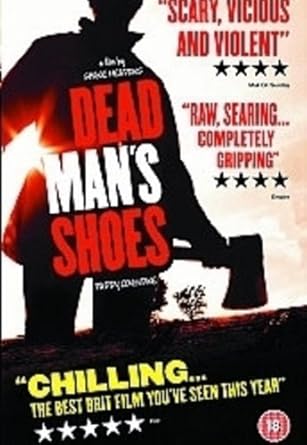
DEAD MAN'S SHOES
The
silhouette of the man is a signifier and it signifies a theme of
mystery and darkness. This is anchored by the written reviews on the
poster.
The
axe being held by the silhouette of the man is a denotation,
this connotes the perhaps evil intentions of the man. This
is anchored by the use of the colours red and black which can connote a
horror-like atmosphere.
The low angle signifies a dangerous character. Names are smaller than the reviews.
...
PRETTY IN PINK
IDENTS
Only one company ident - Paramount Pictures
With recent films there are usually more than one ident
TITLES IN ORDER
PARAMOUNT PICTURES PRESENTS - upper case and sans-serif -
Black and white connoting seriousness/sophistication/drama genre.
Polysemic title - sans-serif font with white on black.
A JOHN HUGHES PRODUCTION - all upper case, sans-serif.
Expected auteur theory
usually "Film" and not "Production".
SHOTS
Exposition shot - narrative enigma. Some degree of context - a working class area (grass growing over pavement, rusty car, broken roads)
Panning shot showing both sides of the track - Born/from the wrong side of the tracks - One side is a nice area than the other.
The director of a film will always be credited twice
What do they do?
- Titles provide the audience with the knowledge of who will appear in a film, as well as who wrote, directed and produced the film.
- They also provide the audience with the knowledge of the companies that had not been involved in the idents, particularly smaller subsidiaries
How long do they last & how many are there?
- In general, titles usually last about 3 minutes long. There are exceptions however.
- The Worlds End doesn't have the typical titles you would expect in a movie opening, it has titles that are the names of the characters and doesn't show the production context whatsoever. This title sequence also lasts 1:30.
THE WORLDS END
- A film opening may have anywhere between 20-30 titles, there can sometimes be more or less, as some films only show the companies involved with production and the director.
BABY DRIVER
Start and end time of main titles: 5:53-8:20
Running time of main titles: 2:33
- Baby Driver was co-produced by both Working Title & Big Talk Pictures
- American Indie company Media Rights Capital
- UK subsidiary company Big Talk Productions (ITV)
- UK subsidiary company Working Title (NBCUniversal)
The titles were all uppercase, and are noted below in order
(Distribution Company x2) - Present
A (Production Company x2) - Production
A Film by (Director & Writer)
Film Title - BABY DRIVER
(Actors name)
(Actors name)
(Actors name)
(Actors name)
with (Actors name)
and (Actors name)
(Actors name)
(Actors name) x3
Casting by
Choreography by
Costume designer
Music by
Editors
Production Designer
Director of photography
Executive producers (x3)
Executive producers (x3)
Produced by (x3)
Written & Directed by
71'
Start and end time of main titles: 0:40-0:49
Running time of main titles: 0:09
(Distribution Company x2) - Present
(Distribution Company x2) - Present
A (Production Company x2) - Production
- 71' is a Warp Production, Warp generally don't put the names of actors, choreographers, set designers, or clothing designers in their main titles, until the end of the film.
- Warp films typically don't rely on star power as much as WT productions do, therefore they do not have any names of actors in their titles
- The name of the director of 71' also does not appear in the titles, the director is 'Yann Demange'.
IDENTS
What are idents?
- Idents are what production companies use to show that they played a part in the production of the movie, and are essentially the production companies Logo.
- Typically in Indie films, an ident lasts between 1-5 seconds long.
- They play an important role, as there is a lot of competition between production companies, however production companies such as the Big Five (e.g. Warner Bros., Paramount Pictures, Universal Studios, Columbia Pictures and Walt Disney Studios) are the most dominant companies when it comes to both production and distribution, allowing them to more easily get a theatrical screening.
- Behind a movie, there are typically 3 company idents, allowing the risk to be spread between them incase the movie fails and is received poorly by the audience.
- The range for the amount of idents you see differs between 1 and 5, both being very extreme and rare cases.
- The last ident shown on screen will also usually have an audio bridge between it and the actual opening of the movie.
- Some indie movies have absolutely no ident before the 1st shot of a film
- Big Five Idents typically last longer than other idents as there is more money spent on them, and they are more well known. For example, the Universal Studios Ident, lasts 24 seconds. The Paramount Pictures ident, lasts 18 seconds, and the Walt Disney Pictures ident, lasts 31 seconds.
- Idents typically use CGI and have an orchestral piece of music behind them, such as the Universal Pictures ident.
Examples of idents you typically see in Indie Films
What's the point of an ident?
- An ident is used to show which companies have been a part of the production and distribution of a film.
- Sound effects in idents are used to signify the genre of the film, or are specific to the ident, this is evident with every ident. For example, with the Universal Pictures sound effect/music, you can automatically tell it's Universal Pictures just by listening to it, without visuals.
Comparison between Indie and Conglomerate
Four Lions (2010) - Budget GBP2.5m
- Was less likely to get theatrical distribution in comparison to WT productions
- Asian/Middle Eastern cast - General bias against non-white protagonists
- Originally in UK - 115 screens; it then doubled as it earned GBP58k - USA took 9 months to distribute this was because of the subject of terrorism that this film tackled.